
STS Risk Calculator: Lung Cancer Resection
General Thoracic Surgery Database
Answer All Applicable Questions for Optimal Estimates
Required Fields
Required Questions
Type of Lung Resection
Surgical Approach
Clinical Cancer Staging
Tumor Size
Value out of usual range, disregard if correct.
T Stage
Lymph Nodes - N
Metastasis - M
Histology
Answer All Applicable Questions for Optimal Estimates
Tumor Location
Lung:
Lobe:
Induction Treatment
Demographics
Sex
Age (Years)
Height
Value out of usual range, disregard if correct.
Weight
Value out of usual range, disregard if correct.
Race/Ethnicity
Risk Factors/Comorbidities
Prior CT Surgery
Surgical Priority
ASA Classification
ECOG Score
Cigarette Smoking
Pulmonary Function
FEV1 Predicted (%)
Value out of usual range, disregard if correct.
DLCO Lowest Predicted (%)
Kidney Function
Last Creatinine
Value out of usual range, disregard if correct.
Cardiovascular Disease
Vascular Disease
Post-Operative Data
Pathologic Cancer Staging
pT Stage
pN Stage
pM Stage
Post-Operative Events (Select all that apply)
Calculations
BMI (kg/m²)
BSA (m²)
Please answer the required questions in the top left blue
section about:
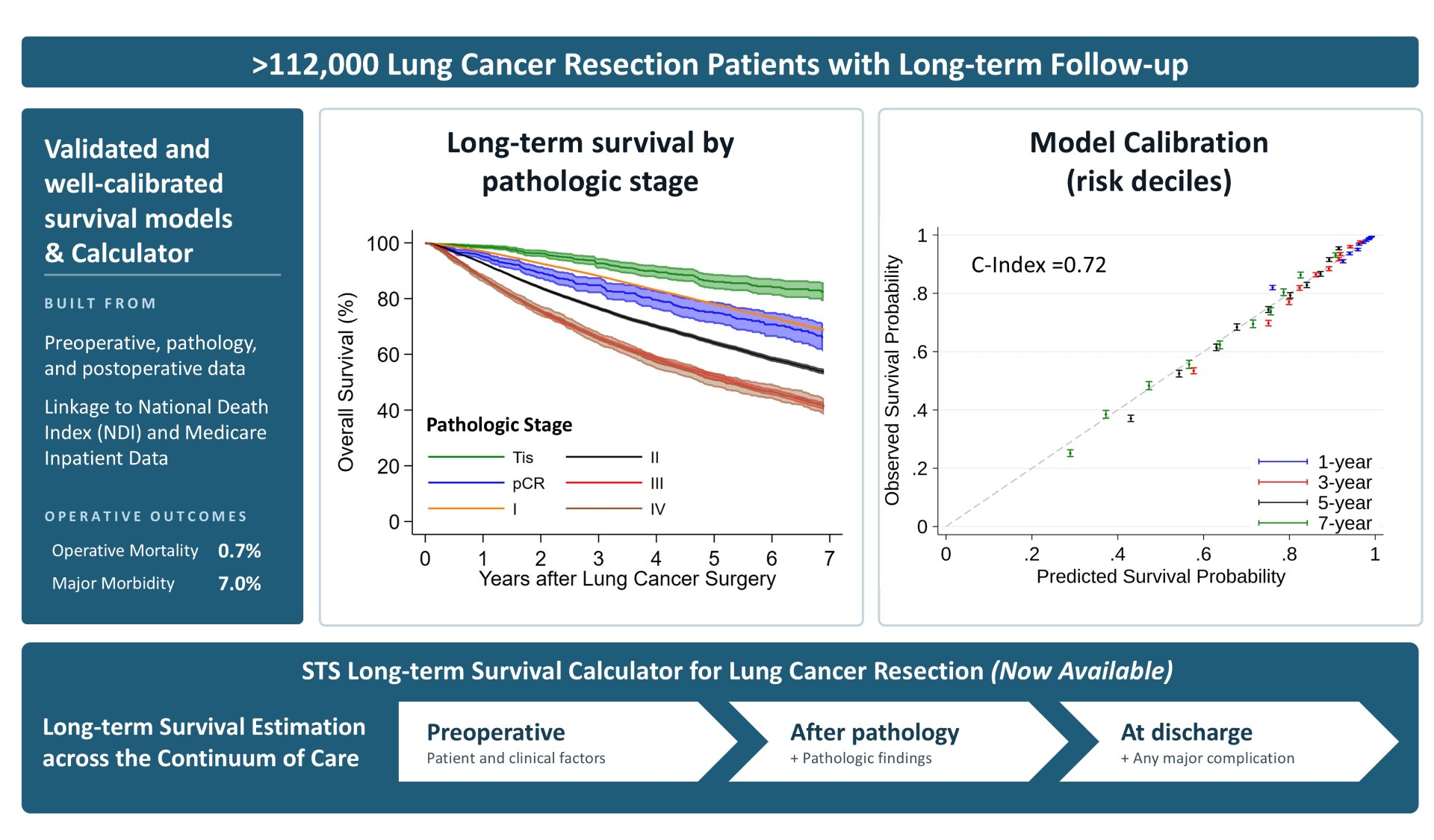
This novel short- and long-term risk calculator for lung cancer resection surgery is based on peer-reviewed and recently published STS Risk models:
-
The STS GTSD Long-Term Pulmonary Resection Risk Model,
recently published
here.
Developed using 112,756 patients from 362 STS participant hospitals between 2015-2023.Feczko A, Abdelsattar ZM, Bonnell L, Chang SC, Khullar OV, Ravanbakhsh S, Habib RH, Seder CW. The Society of Thoracic Surgeons 2026 Long-term Risk Models for Lung Cancer Resection. Ann Thorac Surg. 2026 Nov 5:S0003-4975(26)01097-0. doi: 10.1016/j.athoracsur.2026.10.020. Epub ahead of print. PMID: 42988197.
-
The
STS GTSD Pulmonary Resection Operative Risk Model
providing estimates of operative mortality, morbidity or any
postoperative major complication, or combined morbidity and
mortality.
Developed using 140,927 patients from 337 STS participant hospitals between 2015-2022.Tong BC, Bonnell LN, Habib RH, Shahian DM, Shersher D, Broderick SR, Burfeind WR, Seder CW; Society of Thoracic Surgeons General Thoracic Surgery Database Task Force. The Society of Thoracic Surgeons 2024 Risk Models for Lung Cancer Resection: Continued Refinement and Improved Outcomes. Ann Thorac Surg. 2025 Apr;119(4):777-785. doi: 10.1016/j.athoracsur.2024.07.047. Epub 2024 Aug 27. PMID: 39197635.
Calculator Features:
- Calculator estimates will only start displaying after answers to a small set of critical lung cancer, surgery and patient variables are answered by user.
- Operative risk (short term) and survival (long-term) estimates are updated together and instantaneously with every change to a patient factor or disease variable
-
The long-term feature of this calculator allows for
individualized survival estimation across the continuum of
surgical care. Specifically,
- Preoperative: Estimate survival using patient and clinical characteristics available before surgery similar to short-term only calculator.
- Postoperative – post pathology results: survival estimates may be further refined based on operative and pathologic post-surgical findings such as including histology, pathologic response and staging, and positive margin status.
- At discharge from hospital: survival estimates are also influenced by the patient’s individual postoperative course, and this calculator allows further refinement of the survival estimates at discharge from hospital based on if and what major complications were encountered.
-
User may toggle between:
- mortality and survival estimation
- vary time range of survival estimation (default 0 – 5 years)
- vary the Survival range from (default 0 – 100%)
-
Answering all or as many as possible of the questions will:
- enhance the accuracy of both short- and long-term risk estimates; and
- allows the construction and display of a comprehensive clinical summary of the patient case being simulated
- All calculator views may be saved as PDF documents, or a screenshot feature may also be used, for clinical documentation purposes
Social/Insurance